AccuMAP® Low pH Protein Digestion Kit


Suppress Artificial Deamidation and Disulfide Bond Scrambling in Protein Sample Prep
- Sample preparation completed in 4.5–5 hours
- Highly reproducible digestion results
- Use for reduced and nonreduced proteins


Catalog Number:
Choose a Kit
Size
Catalog Number: VA1040
Catalog Number: VA1050
Suppress Nonenzymatic PTMs During Protein Sample Prep
Nonenzymatic posttranslational modifications (PTMs) spontaneously occur in biotherapeutic proteins during manufacturing and storage. The major nonenzymatic PTMs are deamidation, disulfide bond scrambling and oxidation. These modifications can affect efficacy and stability of biotherapeutic proteins and are the subject of careful monitoring.
Nonenzymatic PTMs can also be induced during protein sample preparation for peptide mapping and can compromise analysis. Major causes of nonenzymatic PTMs induced during sample preparation include alkaline pH and impurities that have protein oxidizing activity.
Suppress Artificial Nonenzymatic PTMs
The AccuMAP® Low pH Protein Digestion Kits suppress artificial nonenzymatic PTMs, as sample preparation is performed at low pH under either reducing or nonreducing conditions.
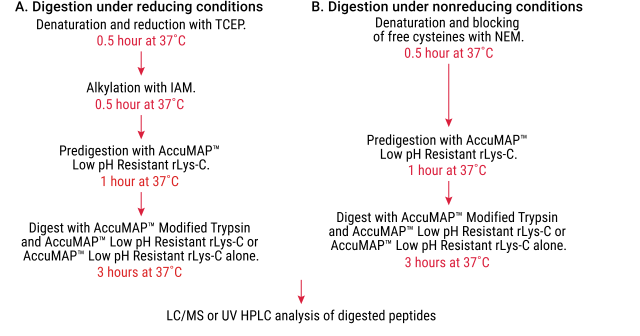
Schematic diagram of sample preparation by digestion performed with AccuMAP® Low pH Protein Digestion Kit.
Protein Digestion at Low pH
Trypsin and other proteases commonly used in peptide mapping sample preparation favor alkaline pH in order to efficiently digest proteins. To avoid artificial nonenzymatic PTMs induced at these conditions, we developed trypsin digestion at low pH. To restore trypsin cleavage efficiency at lysine sites we supplemented trypsin with a special, low pH-resistant recombinant Lys-C (rLys-C) protease. By supplementing trypsin with low pH resistant rLys-C we achieved efficient tryptic digestion at low pH.
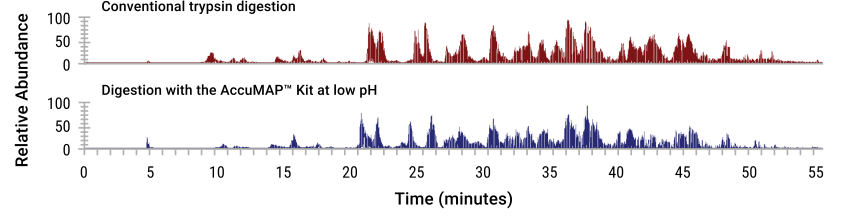
Efficient digestion with modified trypsin and AccuMAP® Low pH Resistant rLys-C at low pH. Rituximab was digested according to a conventional protocol (at pH 8) or with the AccuMAP® Low pH Protein Digestion Kit at low pH and analyzed by LC/MS. The data show that digestion at low pH was comparable to digestion at conventional conditions.
Suppression of Deamidation and Disulfide Bond Scrambling
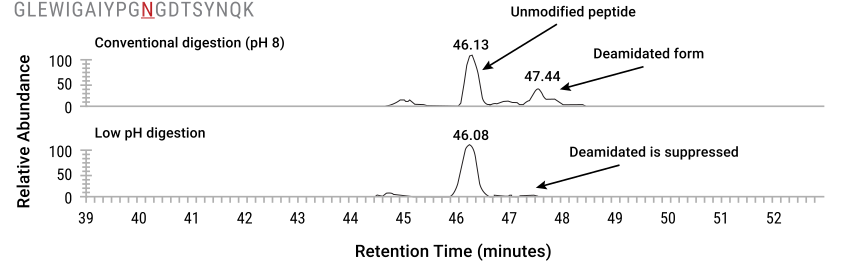
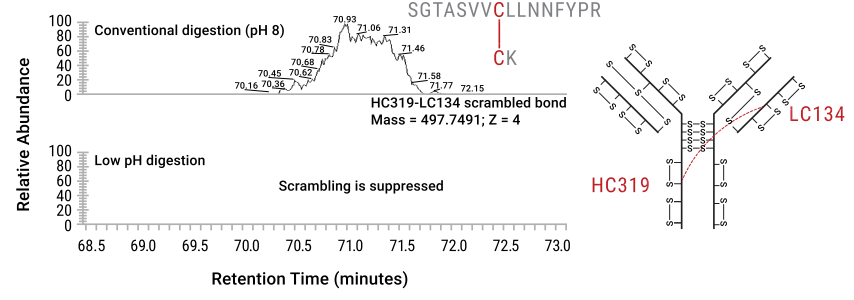
Complete suppression of deamidation and disulfide bond scrambling in IgG digested with AccuMAP® Low pH Protein Digestion Kit. Figure shows extracted ion chromatogram of a GLEWIGAIYPGNGDTSYNQK peptide from Rituximab antibody digested at conventional conditions (pH 8) and at low pH (with AccuMAP® Low pH Protein Digestion Kit). The data show suppression of deamidation in the upper panel and the complete suppression of disulfide bond scrambling in the lower panel.
Minimal Baseline Noise in Tryptic Digests
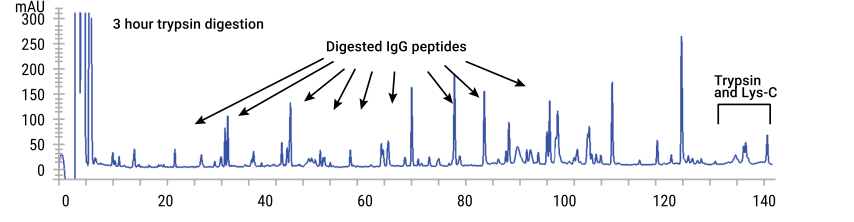
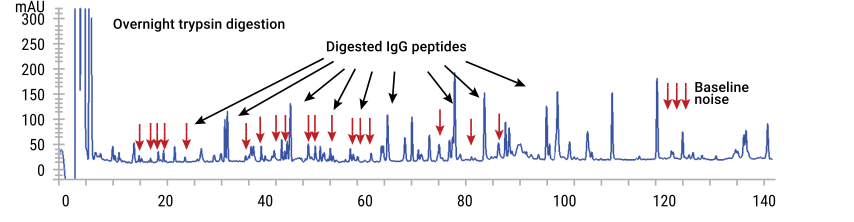
UV-HPLC chromatograms of Panitumumab digests. Panitumumab was predigested with AccuMAP® Low pH Resistant rLys-C, then the reaction was diluted and digestion was completed by incubation with trypsin for 3 hours (upper panel) or overnight (lower panel). In this experiment we used a 1:5 trypsin:protein ratio. Note the accumulation of baseline noise for the overnight digest shown in the lower panel.
Low-pH Mapping Method Using rLys-C and Modified Trypsin
This publication illustrates the development of a platform low-pH peptide-mapping method using a combination of low-pH-resistant Lys-C and modified trypsin to maintain succinimide stability, eliminate deamidation assay artifacts, and achieve efficient mAb digestion equivalent to the conventional tryptic peptide-mapping method under alkaline conditions.
An Automated and Qualified Platform Method for Site-Specific Succinimide and Deamidation Quantitation Using Low-pH Peptide Mapping. (2019) J. Pharm Sci. Jul 30. pii: S0022-3549(19)30485-X. doi: 10.1016/j.xphs.2019.07.019
Characterization and Quantification of Succinimide Using Peptide Mapping Under Low-pH Conditions
Characterization of asparagine deamidation and aspartic acid isomerization is an important aspect of biotherapeutic protein analysis. Succinimide has long been known to be an intermediate product, but its analysis remains challenging due to its instability. We have developed a paradigm in which two interlinked analytical methods are used to develop an optimized approach to analyze succinimide. In the first method, low-pH protein digestion is used for detailed characterization of succinimide with peptide mapping. At low pH, succinimide is stable and can be analyzed with accurate mass measurements and tandem mass spectrometry to confirm its identity and localize its modification site.
Characterization and Quantification of Succinimide Using Peptide Mapping Under Low-pH Conditions and Hydrophobic Interaction Chromatography (2019) Anal. Biochem. 566, 151–59.
The AccuMAP® Kit contains all the reagents needed for enzymatic digestion and still offers enough flexibility to adjust to the needs of each particular project. Besides, owing to the low pH conditions, no artifacts (such as deamidation or oxidation) are detected in LC-MS analysis. It is today our first choice for peptide mapping studies, especially for multiple attribute monitoring approaches.
Dr. Claire Butré, R&D Technical Leader, Quality Assistance S.A.
Protocols
Complete Protocol
Specifications
Catalog Number:
What's in the box
| Item | Part # | Choose a size | Concentration | Available Separately |
|---|---|---|---|---|
AccuMAP® Modified Trypsin Solution |
V528C | 2 × 60μg | 0.5μg/μl | View Product |
AccuMAP® Denaturing Solution |
VA100A | 1 × 1ml | View Product | |
AccuMAP® 10X Low pH Reaction Buffer |
VA101A | 1 × 1ml | View Product | |
AccuMAP® 100X Oxidation Suppressant |
VA102A | 1 × 50μl | View Product | |
AccuMAP® Low pH Resistant rLys-C Solution |
VA103A | 2 × 60μg | 200μg/ml | View Product |
TCEP |
VB100A | 3 × 15mg | View Product | |
Iodoacetamide |
VB101A | 3 × 15mg | View Product | |
NEM |
VB102A | 2 × 15mg |
SDS
Search for SDSCertificate of Analysis
Use Restrictions
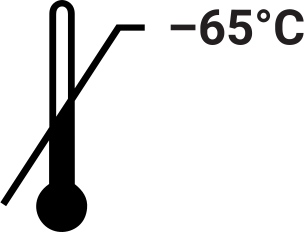
For Research Use Only. Not for Use in Diagnostic Procedures.Storage Conditions
What's in the box
| Item | Part # | Choose a size | Concentration | Available Separately |
|---|---|---|---|---|
AccuMAP® Modified Trypsin Solution |
V528D | 3 × 400μg | View Product | |
AccuMAP® Denaturing Solution |
VA100B | 2 × 5ml | View Product | |
AccuMAP® 10X Low pH Reaction Buffer |
VA101B | 2 × 5ml | View Product | |
AccuMAP® 100X Oxidation Suppressant |
VA102B | 2 × 250μl | View Product | |
AccuMAP® Low pH Resistant rLys-C Solution |
VA103B | 5 × 240μg | 200μg/ml | View Product |
TCEP |
VB100A | 5 × 15mg | View Product | |
Iodoacetamide |
VB101A | 5 × 15mg | View Product | |
NEM |
VB102A | 4 × 15mg |
SDS
Search for SDSCertificate of Analysis
Use Restrictions
For Research Use Only. Not for Use in Diagnostic Procedures.Storage Conditions
Related Products
Similar Products
Trypsin Platinum, Mass Spectrometry Grade
Maximum digest specificity. Maximum resistance to autoproteolysis.
VA9000
Trypsin/Lys-C Mix, Mass Spec Grade
Increased peptide recovery, enhanced protein quantitation, improved reproducibility.
V5071, V5072, V5073
Trypsin Gold, Mass Spectrometry Grade
Maximum digest specificity with extreme resistance to autolytic digestion.
V5280